Plan Ceibal
The social and economic impact of jp.ik technology-based educational projects.
jp-inspiring knowledge (jp.ik) has more than 25 years of experience in the ICT (Information and Communications Technology) field, occupying a place of leadership and reference not only in its national market, but also internationally. Since the beginning JP-IK has been dedicated to the distribution of cutting-edge technological solutions and since 2008 jp.ik has invested in the field of ICT applied to Education.
Introduction
The Presidency of El Salvador is investing in Education as a national priority, in response to the vulnerabilities observed in the national Education system and in society itself.
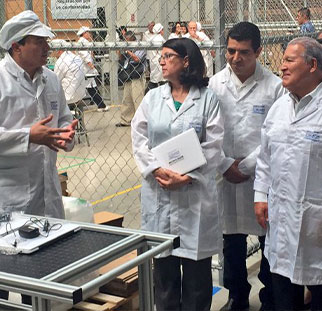
The Presidential Programme “Una Niña, Un Niño, Una Computadora” (A Girl, A Boy, A Computer) was launched in 2015 under the supervision of the Salvadoran Ministry of Education, with the mission of improving the quality of the country’s Education, guaranteeing that teachers have the necessary knowledge to use technology in an educational context and promoting equality of opportunities for students in the access to ICT.
The basis of this initiative lies in the national production of the technological resources – baptised as Lempitas – to be given to each student and teacher. Another fundamental pillar of this initiative is teacher training, on behalf of a meaningful integration of technology in a teaching and learning context.
From Europe to Latin America, from Asia to the Middle East and North Africa and Sub- Saharan Africa JP-IK is present in more than 70 countries, leading a digital revolution in Education as an enabler for the modernization of the education system: empowering teachers and engaging students jp.inspiring knowledge, supports the “CEIBAL PLAN” project, the acronym “Ceibal” stands for “Conectividad Educativa de Informática Básica para el Aprendizaje en Líne” (“Education, Computer, Connectivity to Learn, unprecedented throughout the world for its national reach.”)
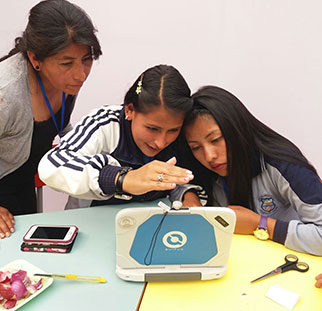
Over the past eight years, jp – inspiring knowledge (jp.ik) has been gathering knowledge and expertise regarding effective and efficient integration of high-level pedagogical and technological solutions in the field of education. In Uruguay, the main objective of Plan Ceibal with the help of jp.ik resources has been the improvement of learning and development conditions and also that every child had access to at least one laptop (LpC).
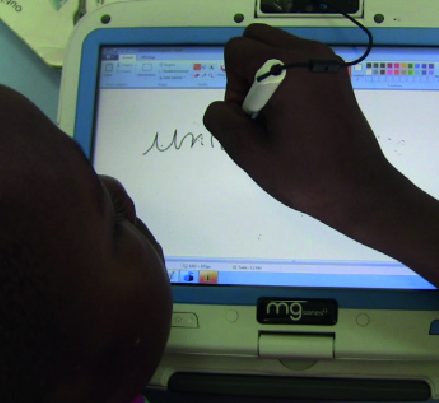
In this regard, jp.ik was part of this project, supplying over 260k laptops, and has worked to ensure that all students and schools have access to the Internet and to various tools and resources that have somehow boosted education in Uruguay.
Therefore, jp.ik’s vision and Plan Ceibal has involved teachers and school leaders more closely when introducing Computer Science (CS) education activities. This means that with this training students will obtain skills such as computational thinking, problemsolving, and collaboration.
Technology can take on two different roles, which must be addressed with different approaches. A role of technology is to facilitate actions that are impossible without it. This role allows to solve problems in the “old way”, which without technology Plan Ceibal could not solve. As an example of this, we can mention, regarding Ceibal, the country library and the teaching of English via videoconference.
Technology is changing the way we perceive our renditions; it is changing the way we relate to each other; it is changing the way we relate to causes and values; it is changing the way we access and collect information; it is changing the way we learn and live.
About Plan Ceibal
The Ceibal Plan was created in 2007 as a national education initiative launched by President Vasquez to incorporate digital devices into education, help bridge a digital gap in the country and provide schools with Internet access by introducing a variety of tools and resources to improve education in Uruguay.
Ceibal is Uruguay’s digital technology center for educational innovation at the service of public education policies. It promotes the integration of technology to improve learning and foster processes of innovation, inclusion, and personal growth.
Plan Ceibal has created school and afterschool activities, in coordination with ANEP1 (National Administration of Public Education), for students to learn computational thinking, robotics and coding skills. These efforts have created a culture where teachers and students are encouraged to use technology to explore innovative and practical applications. The initial top-down organizational structure of the Ceibal Plan allowed the relatively rapid implementation of the One Laptop per Child programme.
During the first years, Ceibal’s focus was on availability with the delivery of devices to students and teachers, as well as the Internet connection of educational centers and logistics to keep the system operating. Once this is cover up, the aim is to complement the delivery of equipment with professional teaching development and the incorporation of technological-educational programs.
The Plan Ceibal is a plan for inclusion and equal opportunities to support Uruguayan education policies with technology. Since its concept, each student entering the Uruguayan public education system has access to a computer for personal use and has a free Internet connection from the educational center.
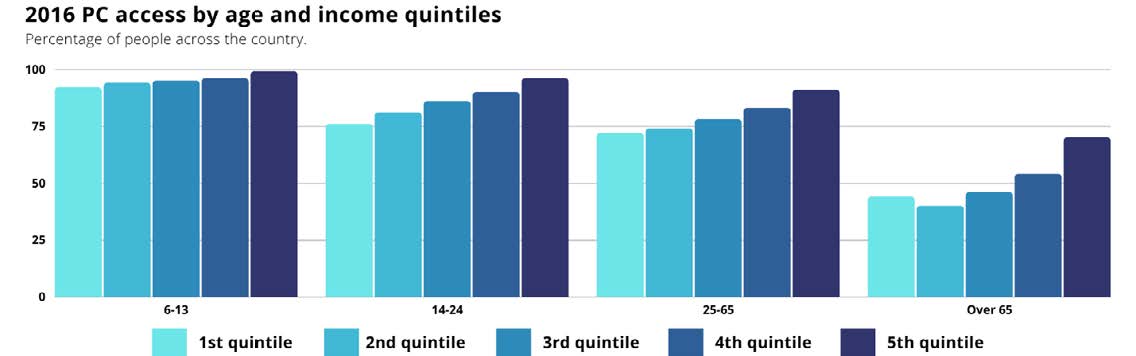
Fifteen years after the Plan started, there is no access gap to the devices. With jp.ik’s help, more than 720,000 students and teachers have access to their own computer and internet in the classroom, the city educational centers have fiber optic and videoconferencing systems and, by using technology in platforms, mathematics, English, robotics and reading have been enhanced, among others.
Objectives
The Ceibal Center has become an innovation agency in technology and pedagogy at the service of the education system. The Ceibal Plan has made remarkable progress towards bridging the digital devices in Uruguay. It is too early to fully understand its impact, as many of its programmes are still expanding. However, Uruguay has been praised for introducing initiatives that foster a culture of innovation.
The Ceibal Plan believes that technology improves education as it creates innovative pedagogical experiences and educational activities that could not be carried out otherwise, such as distance learning, personalization through platforms, distribution of digital books, or the development of combined educational strategies.
Initiative’s main objectives
Digital Inclusion
Graduate Employability
National Digital Culture
Higher-order Thinking Skills
Gender Equity
Student Motivation
Initiative’s main objectives
2007 – 2009: Delivery of devices and Internet connectivity for schools. In this stage devices were delivered to students, teachers and schools were connected to the internet.
2010 – 2012: Deployment of platforms and teacher support. Emphasis shifted to encouraging the use of computers. A new position was created, the Ceibal Support Teacher (MAC), together with multiple platforms for teacher work management, online assessment, and education.
1. Digital Library
2. Adaptive Mathematics Platform (PAM)
3. CREA Platform
4. Online Evaluation System
2013 – 2019: Technologies as accelerators for new pedagogies. The objective is to transform teaching practices through the integration of computers into the learning process. As of 2014, the technological deployment and software programs were maintained, but the use of technology as an accelerator for customized learning processes was increased. Plan Ceibal implements a series of initiatives that put into practice the latest concepts and proposals of contemporary educational knowledge. These initiatives’ objectives, content and design make them examples of “new pedagogies”.
2020 – 2025: In 2020, Plan Ceibal began to transition a fourth phase adjusting its proposals to the needs of the teaching staff through the design of user experiences, increased communication with the education communities and coordination opportunities with ANEP. The aim is to strengthen inter-agency processes within the education system, for example, the creation of the Inter-Agency Data Board composed of Plan Ceibal, ANEP, MEC and INEED. The aim is to enhance international exchanges on the integration of education technologies.
The access to technological devices must necessarily be accompanied by a democratization in access to knowledge
In Uruguay, the only way for all students to access study and reading books is through digital formats. Therefore, the Digital Library was created, allowing access to teachers and students to all the specific contents of textbooks needed to study, as well as entertaining books. In 2015, it was included the opportunity for retirees to access this library. Finally, Plan Ceibal managed to create access to the Digital Library for any Uruguayan resident, and in December 2018, it was launched with the first 4,000 resources available. In this first year, the Library is constantly growing in the number of books and subscribers.
Another example of the impact of technology on methods of teaching and learning is the Ceibal program in English. This arises to respond to the lack of English teachers in Uruguay, to teach the language in all primary education, especially in cities further away from the capital. Jp.ik together with Plan Ceibal developed a network of videoconferences to provide classes in all public centers so that students can learn remotely with teachers from different parts of the world. Thus, the company managed to go from 30,000 children who received English classes to more than 110,000 throughout the country.
Another important role of technologies is to become accelerators of new pedagogies. Therefore, the Ceibal Center focuses on the approach of new pedagogies for Deep Learning through student-centered methodologies. Together with the National Public Education Administration (ANEP), Ceibal joined a set of countries that make up the Global Learning Network; where work is promoted by projects linked to the environment, the center of learning is in the students and teachers and directors are the key actors of this transformation.
In most cases, these projects are linked to technology.
Pedagogical practices and learning environments
Plan Ceibal’s motto is “learning by doing”. Each student is placed at the center of the learning process, which is supported by technology.
They promote collaborative workspaces where they foster a culture of doing and project-based learning. This approach develops key skills for the world we live in.
The use of virtual platforms and digital resources allows learning to take place outside the classroom, extending teaching time and transforming other spaces outside the school into learning spaces. With this technological deployment it is possible to test innovative models such as teaching through videoconferencing.
This ubiquitous learning also allows for greater family involvement; families are catalysts for learning and are also a key pillar of the blended education and global distance learning models that have broadened their scope in recent years.
Beyond the use of technology, Plan Ceibal aims to understand and create technology, learn new languages, and create innovative solutions. To this end, they have developed projects such as STEM that stimulate curiosity, creativity, and computational thinking to be used in any subject.
Among the countries of the NETWORK, the technological changes that have occurred in recent years have defined a completely different world, which requires students to handle certain basic skills, centered on the so-called 6 Cs:
Collaboration
Citizenship
Communication
Critical Thinking
Character
Creativity
However, these technological changes, linked with social changes, call on teachers, more than ever, to accept the challenge of having young people interested in school. Therefore, it is important to think of different pedagogical proposals, so that they remain in the center as much time as possible and that this place becomes fundamental for the support and training of children and young people.
For this difficult task, it is necessary to increase the teaching role, the value given to them in society, but Plan Ceibal also set our sights on a horizon for all.
Collaborative networking, between centers and teachers, is the best way to make sustainable changes. For this to take place, it is essential to have spaces for teachers to share, innovate the curriculum and the educational proposals.
If we want young innovators, we must have innovative teachers. Innovation comes from the environments where children are formed. In addition to working with students, collaboration must happen between teachers and schools. Exchanging ideas generates a virtuous circle in which, based on partnership, more and better ideas are generated.
Teacher’s professional development
It is essential to promote the professional development of teachers to enable the implementation of models and tools, and the use of technologies to enrich pedagogical proposals. The aim is to support teaching staff in their transition to “versatile professionals who believe in their ability to transform themselves, becoming ‘knowledge teachers’, inducers of knowledge’, rather than knowledge teachers”.
This proposal is also based on a set of standards (ISTE-CEIBAL) that promotes the development of teachers as learning subjects, their leadership skills, exercise their digital citizenship, collaborate, facilitate, analyze, and design their pedagogical practices.