Investing in education is the route for the development of a nation.
Kenya Digital Literacy Programme
jp.ik has more than 25 years of experience in the field of ICT, occupying a place of leadership and reference not only in its national market, but also internationally. Since the beginning jp.ik has been devoted to the distribution of high-end technological solutions and since 2008 jp.ik has invested in the field of ICT applied to Education, becoming pioneer in the delivery of a revolutionary educational project based on three dimensions – engineering, technology and training – offering a full, integrated and customized educational solution respecting the traits of each project and ruled by the UN Sustainable Development Goals.
From Europe to Latin America, from Asia to Middle East and North Africa and sub-Saharan Africa jp.ik is present in more than 70 countries, leading a digital revolution in Education as a facilitator for the educational system modernization; empowering teachers and engaging students.
Who & where
The lack of qualified teachers in terms of using and interacting with ICT, the lack of equipments, the still high-priced equipments, the lack of Internet connection or a barely existent one are a few of the distinctive features of a country very eager to bring its own educational system into the 21st century and investing in its own economic and social growth through investing in the Education of its children.
Extremely aware of the importance of technology as a catalyst for the academic success, social inclusion and the economic growth, the Kenyan Government decided that it was urgent to redesign the Education model and bring it to the New Millennium.
What
In 2013 the Kenyan Government kicked off the Digital Literacy Programme built upon a multi stakeholder approach with the participation of several government organizations, committing to the integration of ICT in every single public Primary Schools of Kenya.
In order to implement this Government initiative, it was launched a public competition and 8 proposals were presented, among them Lenovo, Huawei and HP. jp.ik strongly believes in the importance of the participation of local agents for the development of this type of projects. For this reason, jp.ik presented its proposal in collaboration with Moi University. Once more jp.ik’s expertise and know-how in the field of Education was recognized and jp.ik won 2 from the 3 batches.
How
jp.ik participation in this educational project includes equipping 13 500 classrooms; capacitating 30 000 teachers and impacting 695 000 students. jp.ik’s role, in partnership with Moi University, highlights its own capacity to delivery full, integrated and innovative technological solutions which are customized according to the essence of each project. This means that the solution designed by jp.ik regarding the Kenyan educational project settles in its three areas of expertise:
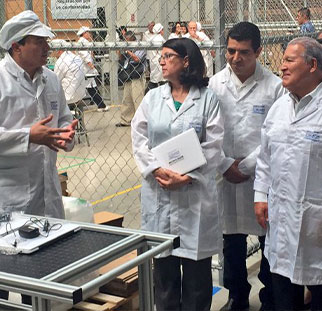
Engineering: an assembly plant which accommodates a post sale service and a call center in Moi University.
Technology: set up of digital classrooms and Classroom Management software and the delivery of equipments to teachers and students.
Training: capacitating teachers, students and the assembly plant workers in accordance to their skills and their jobs specifications.
When
This educational project in collaboration with Moi University which started during the last quarter of 2015 is already in development phased into three stages:
Proof of concept
• Setting up of 79 digital classrooms;
• Training 145 teachers;
• Delivering 6197 equipments.
Phase II
• Implementation of the project in large scale. In the field there is a team of 300 professionals directly involved in the project.
• 100 classrooms are set up per day, in other words, 500 per week.
• An average delivery of 25.000 equipments per week.
Phase III
• Total of 13.500 digital classrooms
• Total of 45.000 teachers trained
• Total of 695.000 students impacted
Why
For a Government investing in the Education means to ensure its Nation’s future; to secure its economic development, and to uphold cultural and intellectual enrichment of its citizens and social inclusion. Thereby investing in the modernization of an educational system, bringing it to the 21st century is not, at all, a closed project. The ramifications that impact society and which are the outcomes of this kind of revolutionary educational projects are present in a variety of sectors of society:
Engineering
• New job creation (directly and indirectly): All the people involved in the project and the workers of the assembly plant; Fostering industrial and economic developmentof adjacent areas (paper, plastic); Promoting the development of new skills.
• Boosting business growth: Setting up a factory locally decreases the distance between demand-supply by lowering costs and the selling price. Diversifying of the portfolio (rising from tablets to smartphones, desktops and portable PCs) increase competitiveness.
Technology
Delivering technological devices to the school community which promotes a first approach to educational technologies.
Delivering Classroom Management software essential for teachers in order to prepare and conduct classes.
Training
Delivering technological devices to the school community which promotes a first approach to educational technologies.
Delivering Classroom Management software essential for teachers in order to prepare and conduct classes.